Published
The short answer
A bullnose verandah has a corrugated-iron roof that curves down over the front beam. It’s one of several curved profiles: the common mid-Victorian Adelaide verandah was concave (the “eyelash”), and bullnose verandahs came later. Rot is most likely at the post bases, the beam ends and the floor, and partly rotted posts and fascias can often be spliced with new timber rather than replaced. Under SA’s planning rules, a like-for-like repair that demolishes nothing and doesn’t harm the building’s structural soundness can be exempt, but not at a local or State heritage place; replacing the whole verandah, or building a new one, is development that needs approval. Every verandah repair in SA is licensed building work.
Bullnose, concave and other curved verandah profiles
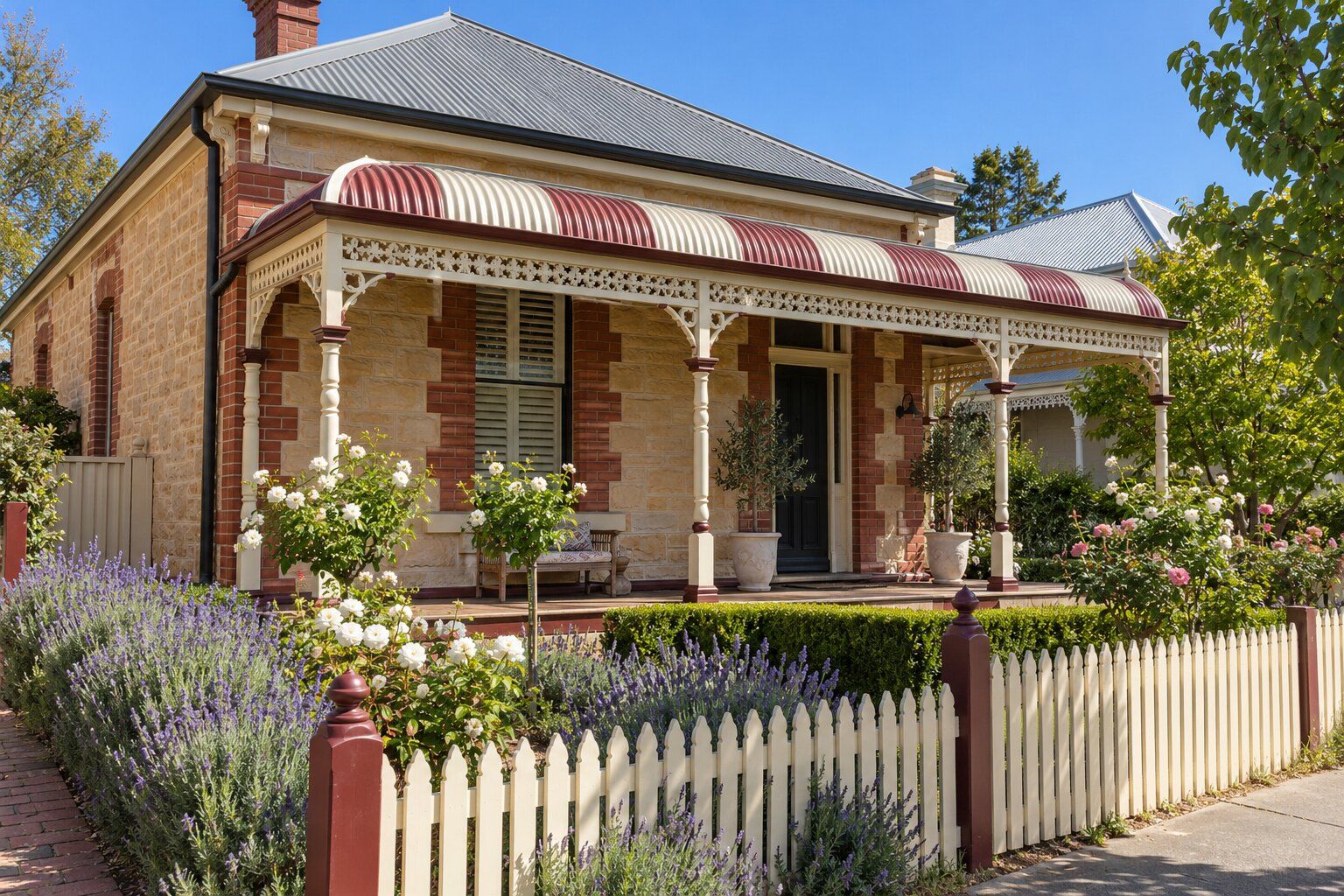
A bullnose verandah has a curved corrugated-iron roof that turns down over the front beam. SA’s heritage note on early roofing says corrugated iron “could also be curved easily”, which led to curved verandah roofs in “a number of profiles such as the convex, the concave, the bullnose and the Ogee”, alongside the straight verandah (DEW Technical Note 3.10). So a curved verandah isn’t always a bullnose.
The City of Adelaide’s heritage notes on verandahs say the most common mid-Victorian Adelaide verandah “was typically a concave (eyelash) profile with square timber posts and decorative mouldings”, and “Later verandahs had a bullnosed profile”. Turned timber posts belong to the later verandahs. Verandah roofs are hipped or gabled in any of these profiles (Norwood Payneham & St Peters council), and an early fashion was to stripe a curved roof by painting alternate sheets in different colours (DEW).
Adelaide verandahs were typically about 2200–2300 mm high, so the underside of the fascia lined up with the front door’s transom. They ranged from 1100 mm to 2500 mm wide, and a common width was 1500–1800 mm. The posts were spaced to frame the front door and the windows beside it, so each window sits in the centre of its span (City of Adelaide).
Parts of a bullnose verandah
Each part has its own timber, size and fixing, and a like-for-like repair copies them.
Verandah posts
Posts were typically 100 mm thick, planed down from a standard 115 mm post; only larger villas had posts up to 120 mm. The City of Adelaide’s notes call off-the-shelf 90 mm posts “a common mistake” because they look “too thin and ‘matchstick’-like”. Posts were typically jarrah or Oregon, plain or more often stop-chamfered, sometimes with moulded capitals, and cast-iron posts can be very ornate. Most had a concealed fixing to the verandah rather than a metal post base, and simple cottages had their posts set into the ground.
The front beam (fascia or bressummer)
SA’s heritage notes call the front beam the fascia; it’s also known as a bressummer. Fascias were typically Oregon, about 220 mm deep and 32–50 mm thick, with a bead along the bottom, and housed into the posts so the posts seem to run up to the gutter, with a timber scotia between them.
Brackets, cast-iron lace and timber fretwork
Cast-iron brackets often sit where each post meets the fascia, or form a decorative valance panel below it. Carved or shaped brackets were used in the same place and were more popular on Edwardian houses (Norwood Payneham & St Peters council). Loose timber fretwork and brackets are refixed, and a broken or missing piece is copied from one that survives.
Curved roof sheeting, hips and gutters
Verandah roofs were heavy, deep-profile iron, tank riveted for strength, with sheets 8 flutes wide rather than 10. Hips were capped with small lead cappings moulded to the iron, and the City of Adelaide’s notes say gutters should be ogee profile and narrower (100 mm) than the main roof gutters. Many SA verandah roofs have no roof framing: the sheets span straight from the wall plate to the fascia. Sheeting, cappings and gutters are roof plumbing, a separate trade from the carpentry quoted here.
Verandah floors
Most SA verandah floors are a low stone retaining wall filled with compacted rubble under a thin slab of unreinforced lime concrete, finished smooth or used as a base for tiles; traditional floors ranged from plain render to slate-edged verandahs with patterned tiles (Norwood Payneham & St Peters council). Timber-framed verandah floors appear on balconies and on rural buildings, particularly where the floor is more than a couple of steps above the ground (SA heritage Technical Note 3.1).
Verandah repairs: rotten posts, beams and floors
SA’s heritage technical note on older buildings calls verandahs “one of the most maintenance-intensive parts of a building”, and the City of Adelaide’s notes say original elements “should be retained and repaired rather than replaced”. Rot is most likely at the post bases, the ends of the beams and the floor.
Rotten verandah post bases
Where posts are set straight into the verandah floor, or paving has been built up around them, the ends rot away, the posts slowly sink, and the timber is exposed to termites. Partly rotted posts can often be repaired with epoxy or by splicing new timber into the sound timber (City of Adelaide). Metal shoes lift post ends clear of the ground, but where a post never had one, the technical note suggests a concealed bracket instead of fitting a shoe that wasn’t there.
Beam ends and fascias
On a timber verandah floor, the outer ends of the boards rot first, then moisture reaches the ends of the main beams where they meet the fascia beam, and “deterioration can be rapid”. End grain soaks up water, so the ends of beams, fascias and barge boards are worth checking. Sinking posts also put the floor frame under strain. A partly rotted fascia can be spliced like a post.
Timber verandah floor boards
The quickest repair cuts all the boards back to the first joist and lays new ends. The technical note prefers taking the boards up and re-laying them cut to two lengths with staggered joints, which keeps more of the original timber, keeps the boards running the right way and avoids a continuous straight joint.
Termites, borers and old paint
The technical note suggests checking for termites or borers at least every 12 months, and calling a qualified pest controller if there’s activity. Old paint on posts and fascias can contain lead: the Commonwealth’s Lead Alert guide (5th edition, 2016) says white lead was used in topcoats for structural timbers, and says not to dry sand.
Common verandah restoration mistakes
Besides thin posts and standard gutters, the City of Adelaide’s notes list a verandah set too high, a verandah base set too high, posts at equal spans rather than framing the door and windows, and tiles run to the edge without a slate or brick border as common mistakes in new and rebuilt verandahs.
Verandah repair cost and quotes in Adelaide
Timber and bullnose verandah repairs are quoted after the verandah has been inspected. The price depends on how many posts are rotten and how far up, whether the beam ends and floor frame are sound, how much fretwork or moulding has to be copied, and whether the roof sheeting or gutters also need a roof plumber.
For a new verandah, an Adelaide builder’s 2026 guide prices flat, skillion and gable verandahs, shown with the PlanSA fees in the pergola and verandah cost guide. It doesn’t price bullnose or heritage verandahs.
What to send for a verandah repair quote
Send photos and a few details, and say what you’d like done:
- Photos of the whole verandah, and close-ups of the post bases, beam ends and floor
- How many posts there are, and whether they’re timber or cast iron
- Any fretwork, brackets or mouldings that are loose, broken or missing
- Whether the house is a local or State heritage place, or in the Historic Area Overlay
- Roughly when the house was built
Do verandah repairs need approval in SA?
Schedule 4 of SA’s Planning, Development and Infrastructure (General) Regulations 2017 lists work that isn’t development. Clause 4(4) covers “the repair, maintenance or internal alteration of a building” that “does not involve demolition of any part of the building” and “will not adversely affect the structural soundness of the building”, other than at a local heritage place. On an ordinary house, like-for-like work such as splicing a post base, replacing rotten floor boards or refixing brackets can fall within it. Where the address or the job changes that:
- Local heritage place: clause 4(4) doesn’t apply, so even a repair is development. External repainting has its own exclusion (clause 4(7)).
- State heritage place: no Schedule 4 exclusion applies (regulation 3C(3)).
- Historic Area Overlay: clause 4(4) excludes local heritage places, not the overlay, but the overlay’s design policies (PO2.3 and PO7.1 in PlanSA’s guidelines) cover the detailing of street-facing verandahs and the demolition of features that show the area’s historic character. Check with your council before work starts.
- Replacing the whole verandah: taking the old one down demolishes part of the building, which clause 4(4) doesn’t cover, and verandahs aren’t in Schedule 4, so a replacement or new verandah is development that needs approval.
- Changing the structure: new posts in new positions, a wider or deeper verandah, or new footings affect the structure, so they’re development wherever the house is. No exclusion applies to a repair that would leave the building not complying with the Building Rules (regulation 3C(4)).
Many new verandahs are “accepted development”, needing building consent only, though the Law Handbook notes exceptions including heritage areas. Check your address with PlanSA’s approval wizard or ask your council. This is a reading of the regulations, not legal advice.
Every verandah repair needs a licensed contractor
Approval and licensing are separate questions. Under SA’s Building Work Contractors Act 1995, repairing a building or part of one is building work, and anyone doing it for others as a business needs a building work contractor’s licence, with no dollar threshold. Consumer and Business Services lists verandahs in its carpentry and its pergolas, verandahs and carports licence categories, so the work is done by a licensed contractor whose licence covers verandahs. See how to check a licence.
Heritage grants and free advice for Adelaide verandahs
Some Adelaide councils help pay for heritage repairs, verandahs included, and several offer free advice from a heritage adviser. Each scheme sets its own rules on which homes qualify, often a listed heritage place or a Representative Building, so check with your council before the work starts. These are the published terms as we found them on 28 October 2026.
City of Adelaide Heritage Incentives Scheme
For minor conservation works of more than $3,000 and up to $150,000, the scheme pays up to 50%, to a maximum of $75,000, and up to 75% of professional advice and documentation, to $15,000. It covers local and State heritage places and other unlisted buildings of significant historic character, on their merits, and verandah reconstruction is among its most common funded projects. General maintenance such as repainting or termite treatment isn’t funded, and there’s no retrospective funding. The council says the budget is “fully allocated for FY 2026/27” and to check its scheme page in June 2027 for the 2027/28 round. Its Heritage Team offers a free initial onsite meeting.
City of Unley conservation grants
Up to 50% of the cost, to a maximum of $5,000, for a heritage place or representative building, including work on the verandah. Work under $1,000 and routine maintenance aren’t eligible, and funded work “must be undertaken by suitably qualified and licensed contractors”. Unley’s page gives the round as Monday 13 July to Friday 31 July, which by our reading of the calendar was the 2026 round, now closed. Unley also runs a free Heritage Advisory service.
City of Burnside heritage grants and advice
Burnside refunds 50% of approved conservation work, to a maximum of $2,000 in a financial year, on projects over $1,000, once per address in five years. Materials must be replaced like for like, and work by the owner or unlicensed tradespeople isn’t eligible. These terms are dated October 2021, and in December 2025 the council said applications would re-open in July 2026, so check the current round on Burnside’s grants page. Its free Building Conservation Advisory Service is for residents “who own an old home (pre-1960) that is not heritage listed (or a Representative Building)”.
City of Prospect Heritage Grant Program
Prospect refunds 50% of conservation work, to a maximum of $2,000 per property, with no minimum, for external work on local and State heritage places and Representative Buildings in the Historic Area Overlay. Its grant page carried a 2026 application form in May 2026; check the current round with the council.
Port Adelaide Enfield heritage grant
Up to 50% of exterior conservation or restoration work that’s visible from the street, capped at $5,000 per grant, for work worth at least $1,000. It isn’t available to an applicant who has had heritage grant funding in the last 3 years. The 2026–2027 grant is assessed as applications are received, and the council’s Heritage Advisor is available on Wednesdays.
Norwood Payneham & St Peters heritage advice
The council’s free Heritage Advisory Service is for owners of State and local heritage places and buildings in the Historic Area Overlay, with the adviser available one day a week. We found no heritage grant on its heritage pages.
State heritage places: Heritage Conservation Grants
The State Government’s Heritage Conservation Grants are for State heritage places only: up to $10,000 (GST exclusive) for residential properties, with a $1,000 minimum, and in most cases dollar for dollar. The 2026–27 program is closed; it opens to applications in December 2026 and closes in March 2027. Advice from Heritage South Australia is free.
Questions about bullnose verandahs
What colour was the underside of an Adelaide verandah?
The City of Adelaide’s heritage notes say the underside “was invariably a light pastel green colour”, such as Eau-de-Nil or Opaline Green.
Can treated pine or laminated verandah posts be used on an old house?
On a heritage verandah, the City of Adelaide’s notes advise against both. Treated perma-pine “is prone to splitting and twisting” and typically comes in 90 mm and other unsuitable sizes, and laminated posts show the laminate’s texture through the paint rather than the natural grain.
Can fretwork or lace be added to a verandah that never had it?
SA heritage guidance says to “avoid adding lace, fretwork or other embellishments to existing verandahs where none originally existed” (DEW, Alterations and Additions, 1997).
How can I find out what my original verandah looked like?
Look for remnants on the house: a half-post against the wall, or a paint outline of the original posts, mouldings or roof profile. The City of Adelaide’s notes say any remnants should be kept and built into the new verandah.
Does repainting a verandah need approval?
At a local heritage place, Schedule 4 clause 4(7) excludes external repainting in the same or similar colours, texture and finish, and painting that doesn’t materially affect the place’s heritage value. At a State heritage place, the Department for Environment and Water says development includes painting.
Can a timber verandah floor be replaced with concrete?
SA heritage guidance doesn’t recommend it where damp-proof courses are likely to be bridged and sub-floor ventilation blocked (DEW, Alterations and Additions, 1997). Adelaide verandah bases were set below the front door threshold to leave room for a vent under the hall floor (City of Adelaide), so a higher floor or path can cover that vent.
Where this information comes from
The rules and guidance on this page come from these published pages, checked on 28 October 2026.
- City of Adelaide: heritage technical notes, verandahs · Adelaide council heritage guidance, drawings dated 30 June 2007 (PDF August 2019)
- Maintenance and repair of older buildings in South Australia (Technical Note 3.1) · SA Government (Department for Environment and Heritage) with Adelaide City Council, July 2008, revised September 2008: technical guidance only
- Early roofing and roof materials in South Australia (Technical Note 3.10) · SA Government (Department for Environment and Water) heritage technical note
- Norwood Payneham & St Peters: front verandah restoration and replacement · Adelaide council heritage fact sheet, undated
- Heritage guideline: alterations and additions · SA Government (State Heritage Branch with the City of Adelaide), October 1997: technical guidance only
- Lead Alert: the six step guide to painting your home (5th edition) · Australian Government guide, 2016
- Planning, Development and Infrastructure (General) Regulations 2017, Schedule 4 · South Australian regulations: Schedule 4 cl 4 (exempt decks, pergolas, fences, sheds, retaining walls)
- PlanSA: Historic Area Overlay design advisory guidelines · SA Government planning guideline, March 2021
- PlanSA: why you need approval · SA Government planning portal guidance, with the approval wizard
- Law Handbook: planning and development · Legal Services Commission of South Australia, building work and accepted development, revised 12 October 2026
- Department for Environment and Water: heritage FAQs · SA Government heritage guidance
- Building Work Contractors Act 1995 (SA) · South Australian legislation: ss 3, 6, 28–36, 47A–47D, 49 and 50
- CBS: building work supervisor standard registration conditions · SA Government, Consumer and Business Services: the licence categories (carpentry, decks, fencing, windows and doors)
- City of Adelaide: Heritage Incentives Scheme · Adelaide council grant page, with the FY 2026/27 funding status
- City of Adelaide: Heritage Incentives Scheme operating guidelines · Adelaide council grant guidelines, adopted 13 February 2024
- City of Unley: conservation grants · Adelaide council grant page and policy (last reviewed 24 June 2024)
- City of Burnside: heritage grants · Adelaide council grant page; terms and conditions dated October 2021
- City of Burnside: Building Conservation Advisory Service · Adelaide council advisory service page
- City of Prospect: Heritage Grant Program · Adelaide council grant page (2026 application form)
- City of Port Adelaide Enfield: Heritage Grant 2026–2027 · Adelaide council grant application form and terms
- Norwood Payneham & St Peters: Heritage Advisory Service · Adelaide council advisory service page
- Department for Environment and Water: Heritage Conservation Grants · SA Government grants for State heritage places, 2026–27 program